
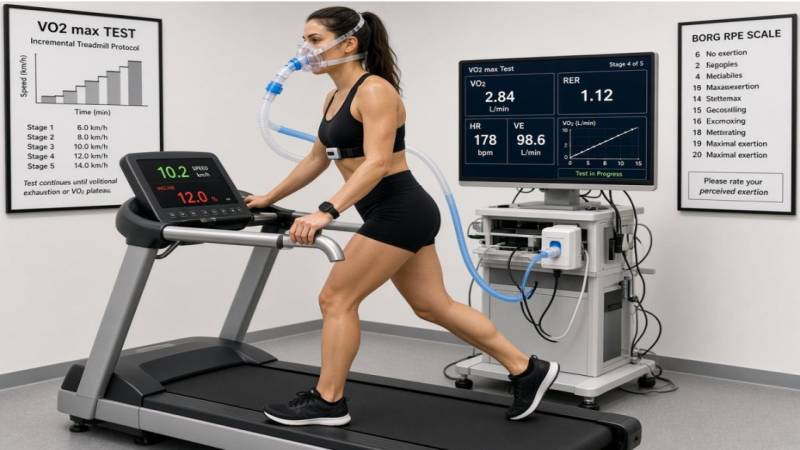
Fitness is increasingly becoming something people want to measure, not simply feel. Weight, workout duration, step counts, and wearable data can provide useful information, but they do not tell the complete story of how efficiently your body performs during exercise. A VO2 max test San Diego can provide a more objective look at aerobic and cardiorespiratory fitness by measuring how your body uses oxygen during progressively harder exercise.
VO2 max refers to the maximum amount of oxygen your body can take in, transport, and use during intense physical activity. It is widely used as a measurement of cardiorespiratory fitness and aerobic capacity.
This guide explains what VO2 max means, how testing works, what the results can reveal, who may benefit, and how to interpret changes over time.
What Is VO2 Max?
Understanding Maximum Oxygen Consumption
VO2 max stands for maximal oxygen consumption. In simple terms, it describes how effectively your body can use oxygen when exercise intensity becomes very high.
During exercise, oxygen must move from the air into the lungs, enter the bloodstream, travel through the cardiovascular system, and ultimately reach working muscles. Those muscles then use oxygen as part of aerobic energy production.
A higher VO2 max generally indicates greater aerobic capacity, although it is only one component of overall fitness. Cardiorespiratory fitness reflects the ability of the heart and lungs to deliver oxygen to working muscles during demanding activity.
Why VO2 Max Is an Important Fitness Metric
VO2 max provides a measurable indicator of aerobic fitness rather than relying only on how long someone exercises or how fit they feel.
Several factors can influence VO2 max, including age, genetics, training status, exercise habits, body composition, and health status. This is why two people completing the same workout may have very different physiological responses.
Rather than treating VO2 max as a single definition of health, it is more useful to view it as one objective measurement within a broader fitness picture.
How Does a VO2 Max Test Work?
Exercise Testing and Respiratory Measurements
A laboratory style VO2 max assessment generally involves progressively increasing exercise intensity while physiological responses are measured.
A typical process may include:
- Completing preparation and health screening.
- Exercising on a treadmill or stationary bike.
- Gradually increasing exercise intensity.
- Wearing a breathing mask connected to metabolic measurement equipment.
- Measuring oxygen consumption and carbon dioxide production.
- Monitoring heart rate and exercise response.
- Continuing to a sufficiently high exercise intensity under appropriate supervision.
Direct measurement of respiratory gases during maximal exercise is considered a highly accurate way to assess oxygen consumption.
The exact protocol can vary according to the testing facility, equipment, individual fitness level, and testing goals.
What Information Is Collected During the Test?
A VO2 max test can generate several measurements that help describe how the body responds to exercise.
VO2 refers to oxygen consumption. It shows how much oxygen the body is using at a particular exercise intensity.
VCO2 refers to carbon dioxide production. Comparing oxygen consumption with carbon dioxide production helps describe the body’s changing metabolic response as exercise becomes harder.
Heart rate provides information about cardiovascular response to increasing workload.
Exercise workload describes how much work is being performed as the test progresses.
Respiratory exchange ratio, or RER, compares carbon dioxide production with oxygen consumption and can provide information about energy metabolism and exercise intensity.
These measurements help turn an exercise session into objective physiological data rather than relying only on perceived effort.
What Can a VO2 Max Test in San Diego Reveal About Your Fitness?
This is where VO2 max testing becomes particularly useful. Instead of simply asking whether you feel fit, testing can provide measurable information about your body’s aerobic response to exercise.
Your Aerobic Capacity
VO2 max provides information about the body’s ability to take in and use oxygen during demanding exercise. This makes it particularly relevant to activities that rely heavily on aerobic energy production.
Runners, cyclists, swimmers, hikers, and other endurance-focused individuals can use aerobic capacity as one way to understand their current fitness level.
VO2 max is commonly expressed relative to body weight in millilitres of oxygen per kilogram per minute, allowing results to be compared across individuals of different sizes.
Cardiovascular Fitness
Cardiorespiratory fitness involves the ability of the cardiovascular and respiratory systems to support sustained physical activity.
VO2 max is an important measurement of this capacity, but it should not be treated as a complete assessment of health. Fitness also includes muscular strength, flexibility, body composition, balance, and other components. ACSM’s current fitness framework recognises multiple components rather than reducing fitness to one measurement.
Exercise Performance
Athletes and active individuals can use objective measurements to establish a baseline for aerobic capacity.
For example, a runner may want to understand current aerobic fitness before beginning a structured training cycle. A cyclist may want objective information to complement training data such as heart rate, power, pace, and recovery.
The value comes from putting the measurement into context rather than assuming that one number automatically predicts performance.
Training Response
Repeat testing can help identify whether aerobic capacity has changed following a consistent training program.
For example, establishing a baseline and repeating the assessment under comparable conditions can provide another data point alongside workout performance and training records.
A change in VO2 max does not guarantee a specific improvement in athletic performance. Instead, it provides measurable evidence that can help evaluate changes in aerobic fitness over time.
Who Can Benefit From VO2 Max Testing?
VO2 max testing can be useful for different people depending on their goals, health status, and interest in measurable fitness data.
Runners and Endurance Athletes
Distance runners, cyclists, triathletes, swimmers, and other endurance athletes may use VO2 max testing to understand aerobic capacity and establish a baseline.
The information can complement training metrics and help provide a clearer picture of current fitness.
Recreationally Active Adults
You do not have to be a competitive athlete to be interested in VO2 max testing.
People beginning structured fitness programs may want an objective starting point. Others may simply want to understand whether their aerobic fitness is changing as they become more active.
Fitness and Performance Enthusiasts
Individuals who follow structured training may combine VO2 max data with heart rate information, strength measurements, body composition testing, and other assessments.
It is important to distinguish fitness testing from medical evaluation. A VO2 max test measures exercise-related physiological responses, but it does not replace appropriate medical evaluation when symptoms or health concerns are present.
VO2 Max Test vs. Other Fitness Assessments
Different fitness assessments answer different questions. Combining them can provide a broader picture than relying on one measurement.
VO2 Max Testing vs. Metabolic Testing
VO2 max testing focuses primarily on aerobic capacity during exercise.
Metabolic testing can involve broader measurements depending on the protocol. For example, a resting metabolic rate test evaluates energy expenditure while the body is at rest rather than during progressively harder exercise.
This distinction matters when choosing a test. Metabolic testing San Diego may be more appropriate for questions about resting energy expenditure, while VO2 max testing focuses on exercise capacity.
VO2 Max Testing vs. Body Fat Testing
VO2 max testing primarily evaluates aerobic capacity.
Body fat testing focuses on body composition, including the proportion and distribution of fat and lean tissue. These measurements answer different questions.
Someone can have a favourable body composition without having the same level of aerobic fitness as another person. That is why body composition and aerobic capacity should not be treated as interchangeable measurements.
VO2 Max Testing vs. DEXA Scan
A DEXA scan can provide detailed information about body composition and, depending on the type of scan, bone density.
VO2 max testing evaluates exercise-related aerobic capacity. DEXA evaluates different physical characteristics.
For individuals interested in comprehensive fitness tracking, these assessments can complement one another rather than compete with one another.
How to Prepare for a VO2 Max Test
Preparation requirements can vary between testing facilities and protocols, so the provider’s instructions should take priority.
Depending on the testing procedure, you may be advised to avoid unusually strenuous exercise beforehand and arrive wearing comfortable athletic clothing and appropriate footwear.
Food, caffeine, hydration, medications, and other factors may also affect testing conditions. Follow the facility’s specific instructions instead of assuming that one preparation routine applies to every test.
It is also important to tell the testing professional about relevant health concerns, medications, recent illness, or other factors that could affect exercise testing.
Good preparation helps create more consistent testing conditions and makes the results easier to interpret.
How to Understand Your VO2 Max Results
VO2 Max Is Individual
There is no single VO2 max number that defines fitness for everyone.
Age, sex, training history, exercise modality, testing protocol, and other individual characteristics can influence results. Reference standards are therefore important when interpreting cardiorespiratory fitness measurements.
Look at Trends, Not Just One Number
One result provides a snapshot. Repeated measurements can provide a trend.
If future tests use comparable conditions, changes can be considered alongside training volume, workout performance, heart rate, recovery, and other relevant information.
A baseline can therefore be more useful than simply asking whether a single number is high or low.
Professional Interpretation
Professional interpretation can add context to the raw data.
A qualified professional can help explain what the measurements mean in relation to the individual’s goals, training history, and testing conditions. If unusual symptoms occur during exercise, they should be addressed appropriately rather than dismissed as part of fitness testing.
Why Objective Fitness Testing Matters
It is easy to say, “I feel fitter,” after several weeks of training. Objective measurements can add another layer of information.
A VO2 max assessment can establish a baseline and provide measurable data that can be compared over time. That information can complement training logs, heart rate data, strength measurements, body composition assessments, and everyday performance.
The important point is not to make one number responsible for defining your entire fitness level. Fitness is multidimensional.
Objective testing is most useful when the information is placed into context and used to support better decisions about training, recovery, and long-term fitness goals.
Frequently Asked Questions About VO2 Max Testing in San Diego
What does a VO2 max test measure?
A VO2 max test measures oxygen consumption during progressively harder exercise. It provides information about aerobic capacity and cardiorespiratory fitness.
How long does a VO2 max test take?
The total appointment and exercise portion can vary depending on the testing protocol, preparation, and individual response. The testing professional can explain the expected duration before the assessment.
Is a VO2 max test difficult?
The test becomes progressively more challenging because exercise intensity increases. The goal is to measure the body’s response at high exercise intensity, so the experience can feel demanding.
Can beginners take a VO2 max test?
Beginners may be able to complete VO2 max testing, but suitability depends on individual health, fitness level, screening requirements, and the testing protocol. People with health concerns should discuss appropriate exercise testing with a qualified professional.
How often should VO2 max testing be repeated?
There is no universal testing interval. The appropriate timing depends on the individual’s goals, training program, and reason for testing. Repeating testing under similar conditions can make changes easier to evaluate.
Is VO2 max the only way to measure fitness?
No. VO2 max is one important measure of cardiorespiratory fitness, but overall fitness also includes muscular fitness, body composition, flexibility, and other factors.
Conclusion:
Metabolic testing provides a clearer understanding of how the body uses energy at rest. A resting metabolic rate test can help establish a more personalized starting point for nutrition and weight-management planning, especially when general calorie calculators do not reflect individual energy needs.
However, RMR is only one part of the bigger picture. Physical activity, body composition, exercise performance, and daily habits also influence energy requirements. Combining these factors can provide a more complete understanding of your needs and help guide more informed decisions about nutrition and fitness.
For those considering metabolic testing San Diego, understanding what each assessment measures can help you choose the right approach for your goals. By combining metabolic testing with relevant assessments, such as body composition or VO2 max testing, you can gain a broader perspective on your energy needs and physical fitness.See More