
The American healthcare system is undergoing one of the most significant technological transformations in its history. From coast to coast, hospitals, private practices, telehealth platforms, and outpatient clinics are rapidly integrating AI medical assistant technology into their daily workflows. These intelligent systems are not simply automating paperwork — they are fundamentally changing how clinicians make decisions, how patients access care, and how medical organizations manage their resources.
In this comprehensive guide, we examine the top 7 AI medical assistant tools that are leading this revolution in the United States. We evaluate each platform based on capabilities, HIPAA compliance, integration depth, patient outcomes, and overall value for healthcare providers. Whether you are a solo practitioner, a growing group practice, or a large hospital network, understanding these tools is no longer optional — it is essential.
What Is an AI Medical Assistant?
Before we dive into the top platforms, it is important to understand what we mean by a medical AI assistant. In the broadest sense, a medical AI assistant is any artificial intelligence system designed to support clinical or administrative healthcare functions. These systems range from simple chatbots that answer patient inquiries to sophisticated AI-powered medical assistant platforms capable of reading diagnostic imaging, transcribing physician notes, predicting patient deterioration, and guiding clinical decision-making in real time.
A robust real-time AI medical assistant can process enormous volumes of patient data — including electronic health records (EHRs), lab results, medication histories, and insurance claims — and surface actionable insights in seconds. This is a capability no human staff member, regardless of skill or experience, can replicate at scale.
According to AI assistant medical information guidelines published by leading US health bodies, these tools must be transparent, evidence-based, and designed to augment rather than replace clinical judgment. The best platforms on the market in 2026 honour this principle rigorously.
The Top 7 AI Medical Assistant Tools in the USA
1. HelpSquad Healthcare— Best Fully Managed AI-Powered Healthcare Virtual Assistant
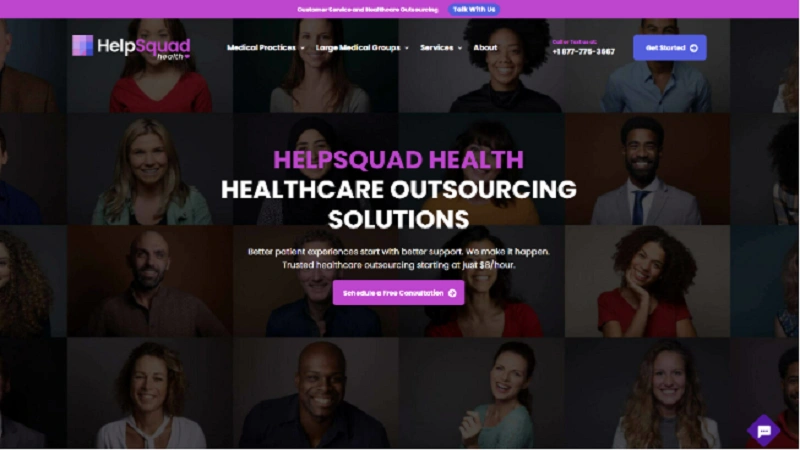 HelpSquad is the most comprehensive and battle-tested AI medical assistant solution currently available in the United States, and it earns its place at the top of this list for multiple compelling reasons. Unlike purely software-based tools, HelpSquad combines the power of AI-driven automation with the irreplaceable judgment of highly trained, HIPAA-certified human virtual medical assistants — creating a hybrid model that delivers unmatched reliability, compliance, and clinical sensitivity.
With over 15 years of experience in healthcare outsourcing, HelpSquad has developed a deeply nuanced understanding of what American medical practices actually need. Their “Managed Service” model is what truly sets them apart from the competition. When you partner with HelpSquad, you are not simply purchasing software or hiring a freelancer. You are gaining a fully managed infrastructure that assumes complete responsibility for hiring, onboarding, training, quality assurance, performance management, and regulatory compliance — across the entire lifecycle of the engagement.
What HelpSquad Offers
HelpSquad’s virtual medical assistant services cover an exceptionally wide range of clinical and administrative functions:
- Patient scheduling and appointment management — HelpSquad’s trained medical virtual assistants handle inbound and outbound appointment calls, reduce no-shows through proactive reminders, and manage complex multi-provider calendars with precision.
- Insurance verification and prior authorization — One of the most time-intensive tasks in any medical practice, insurance verification is handled seamlessly by HelpSquad’s VAs, who work directly within your existing EHR and EMR platforms, including Epic, Cerner, Athenahealth, Veradigm, and eClinicalWorks.
- Medical billing and coding support — HelpSquad’s assistants are trained in medical billing workflows, helping practices reduce claim rejection rates, accelerate reimbursement cycles, and minimize costly coding errors.
- HIPAA-compliant patient communications — Every interaction handled by HelpSquad’s team is governed by strict HIPAA protocols. A formal Business Associate Agreement (BAA) is signed with every client before services begin, covering PHI handling, breach reporting, and all required security standards.
- 24/7 support coverage — HelpSquad provides round-the-clock availability, including after-hours, weekends, and holidays. This means urgent appointment requests, overflow calls, and patient inquiries never go unanswered.
- AI-powered Agent Assistants — HelpSquad integrates AI tools that enhance the performance of their human agents, enabling real-time suggestions, faster data retrieval, and smarter patient triage.
- Bilingual (English/Spanish) support — Given the diversity of the US patient population, HelpSquad’s bilingual virtual assistants ensure that language barriers never compromise patient care quality.
- Scalable team building — Whether a practice needs one part-time VA or an entire managed call centre team, HelpSquad scales to meet demand without disruption.
Why HelpSquad Outranks Pure-AI Solutions
Many practices have discovered that fully automated AI systems, while impressive on paper, struggle with the nuanced, emotionally sensitive nature of healthcare communications. Patients calling about abnormal lab results, medication side effects, or mental health concerns need a response that is not only accurate but deeply human. HelpSquad’s hybrid model — pairing AI efficiency with trained human empathy — consistently produces superior patient satisfaction scores compared to purely automated alternatives.
Every client receives a dedicated US-based Account Manager who oversees the VA team, manages transitions, handles performance issues, and ensures that the service continuously evolves to meet the practice’s changing needs. This level of proactive management is virtually unheard of among other virtual medical assistant companies.
HelpSquad’s pricing starts at just $8.50 per hour, making it one of the most accessible entry points in the industry for practices seeking professional, managed virtual medical assistant support. For practices looking to scale, monthly managed packages offer comprehensive team-based solutions at a predictable cost.
“It’s like having someone there 24/7 to answer questions and provide information to customers. They are a great company, exceptional service, and reasonable prices for what they offer.” — Verified HelpSquad Client
Best for:
Medical practices, hospitals, dental offices, behavioural health providers, and healthcare groups of any size seeking a fully managed, HIPAA-compliant, AI-enhanced virtual medical assistant solution with zero day-to-day management overhead.
2. Nuance DAX Copilot — Best AI Medical Scribe for Clinical Documentation
Nuance DAX (Dragon Ambient eXperience) Copilot, developed by Microsoft, is one of the most widely adopted medical assistant AI tools in the United States for ambient clinical documentation. DAX Copilot listens to the natural conversation between a physician and patient during a clinical encounter and automatically generates a structured, high-quality clinical note — dramatically reducing the documentation burden that drives physician burnout.
DAX Copilot does not attempt to replace clinical judgment — it operates strictly as a documentation assistant, capturing what clinicians say and organizing it into structured chart entries that physicians then review and approve. This is fully aligned with AI assistant medical information guidelines that emphasize the need for physician oversight in AI-generated clinical content.
Best for:
Clinicians and health systems are seeking to dramatically reduce documentation time while maintaining full physician control over clinical notes.
3. Nabla Copilot — Best AI-Powered Medical Assistant for Independent Practices
Nabla Copilot is a purpose-built AI-powered medical assistant designed specifically for independent and small-to-mid-size medical practices that want enterprise-grade AI capabilities without enterprise-grade complexity or cost. Like Nuance DAX, Nabla functions as an ambient AI scribe — but it distinguishes itself through a remarkably simple setup process, competitive pricing, and a user interface that clinicians consistently describe as intuitive and minimally disruptive to their workflow.
Nabla has garnered strong adoption among US-based independent physicians who want a real-time AI medical assistant that genuinely reduces their administrative load without requiring dedicated IT support or lengthy implementation cycles.
Best for:
Independent physicians and small group practices seeking an affordable, easy-to-deploy AI documentation assistant with multi-speciality support.
4. Amazon Health AI — Best Consumer-Facing AI Medical Assistant
In early 2026, Amazon expanded its Health AI platform beyond One Medical subscribers to the general public via Amazon.com and the Amazon mobile app. This move marked a significant milestone in the democratization of AI doctor chatbot technology in the USA, bringing a sophisticated, conversational health assistant to millions of American consumers who previously had no easy access to personalized health guidance.
Amazon Health AI can answer general health questions, explain recent lab results, assist with prescription renewal requests, book appointments with healthcare providers, and connect users with telehealth services — all within a familiar, conversational interface. Importantly, the platform is designed to serve as a personalized health assistant that can offer increasingly tailored guidance as it builds context about an individual user’s health history.
Best for:
Consumer-facing health organizations, telehealth platforms, and practices looking to integrate AI patient engagement tools at scale.
5. Suki AI — Best AI Medical Assistant for EHR Integration
Suki AI is a voice-enabled medical assistant AI platform that has earned a loyal following among US physicians for its deep, seamless integration with major EHR systems. Suki acts as a voice-activated AI layer on top of existing clinical software, allowing physicians to create notes, retrieve patient information, enter orders, and complete documentation tasks entirely through natural speech — without ever needing to type or click through multiple screens.
Suki is also notable for its continuous learning capabilities. The platform adapts to each individual physician’s documentation style over time, progressively improving the accuracy and relevance of its suggestions. This makes Suki one of the most truly personalized AI-powered medical assistant experiences currently available in the US market.
Best for:
Physician groups and health systems that want a deeply integrated, voice-first AI assistant that works within their existing EHR environment.
6. Regard — Best AI Medical Assistant for Hospital Medicine and Complex Care
Regard is a clinical AI platform designed specifically for hospital medicine — an environment where the volume of patient data, the complexity of care decisions, and the risk of oversight errors are all substantially higher than in outpatient settings. Regard functions as a real-time AI medical assistant that continuously analyzes a patient’s EHR data, including labs, vitals, medication records, and clinical notes, and proactively surfaces potential diagnoses, care gaps, and documentation suggestions to the treating team.
Regard is currently deployed in dozens of US hospital systems and has demonstrated measurable improvements in documentation quality, coding accuracy, and clinician efficiency across the institutions that have adopted it.
Best for:
Hospitalist groups, academic medical centres, and health systems are seeking an AI tool that improves clinical decision support and documentation accuracy in inpatient settings.
7. Consensus — Best AI Medical Assistant for Evidence-Based Research
Consensus is a specialized medical AI assistant built for a specific and critically important use case: helping clinicians and researchers rapidly identify, evaluate, and synthesize evidence from the peer-reviewed medical literature. In a world where over 1 million new medical research papers are published each year, staying current with the evidence base is functionally impossible through manual reading alone.
This capability is directly aligned with best practices outlined in AI assistant medical information guidelines, which emphasize the importance of evidence-grounded responses in clinical AI tools. Consensus does not generate unsupported claims — every assertion it makes is traceable to a specific published source.
Best for:
Clinicians, researchers, academic medical centres, and hospital systems are seeking an AI tool to support evidence-based decision-making and clinical research efficiency.
Why AI Medical Assistants Matter for US Healthcare
The United States faces a compounding healthcare crisis. Physician burnout is at record levels, with administrative burden cited as the leading cause. The Association of American Medical Colleges projects a shortage of up to 86,000 physicians by 2036. Meanwhile, the average American primary care visit lasts fewer than 18 minutes — leaving little room for the kind of thorough, attentive care that patients deserve.
AI-powered medical assistant technology directly addresses these systemic pressures. By automating scheduling, medical billing and coding, patient intake, documentation, insurance verification, prescription refills, and patient follow-ups, these tools give clinical teams back the time and mental bandwidth they need to focus on what truly matters: the patient in front of them.
Furthermore, as virtual medical assistant services expand, practices no longer need to hire large in-house administrative teams. A single well-integrated AI platform or healthcare virtual assistant service can handle workflows that once required multiple full-time employees, at a fraction of the cost and with greater consistency.
Key Factors to Consider When Choosing an AI Medical Assistant
With so many capable platforms available, selecting the right AI medical assistant for a specific healthcare organization requires careful evaluation across several critical dimensions.
HIPAA Compliance and Data Security
This is non-negotiable. Any AI tool that touches patient data must be fully HIPAA-compliant and should be willing to execute a Business Associate Agreement (BAA) before any PHI is accessed. Organizations that cut corners on compliance — including many offshore freelance VA services — expose their practices to severe legal and financial penalties. Among the virtual medical assistant companies reviewed here, HelpSquad stands out for making the formal BAA a mandatory prerequisite before services begin, a standard that many competitors fail to meet.
EHR and EMR Integration
A healthcare virtual assistant or AI platform that cannot integrate with a practice’s existing EHR system will create workflow friction rather than eliminating it. The best platforms offer native integrations with Epic, Cerner, Athenahealth, and other major systems. HelpSquad’s VAs are trained to work directly within whichever EHR a practice uses, while platforms like Suki and Nuance DAX offer deep, native EHR connections at the software level.
Human Oversight and AI Transparency
As emphasized in current AI assistant medical information guidelines, all AI-generated clinical content must be reviewed by qualified healthcare professionals before it influences patient care decisions. Platforms that clearly delineate what the AI does versus what the clinician controls are more trustworthy and safer to deploy.
Scalability and Support
Healthcare organizations change. Practices grow, acquire new locations, expand into new specialties, and face fluctuating patient volumes. The ideal virtual medical assistant platform scales with these changes without requiring a complete reimplementation. Among virtual medical assistant companies, HelpSquad is unique in offering a fully managed scaling pathway — from a single part-time VA to an entire managed call center — without requiring the practice to take on any additional hiring or management burden.
Cost and Return on Investment
The true cost of an AI medical assistant must be weighed against the time, labour, and error-correction costs it eliminates. HelpSquad’s virtual medical assistant services, starting at just $8.50 per hour, can replace the equivalent of multiple in-house administrative staff at a dramatically lower total cost — while also improving consistency, compliance, and patient satisfaction.
The Future of AI Medical Assistants in the USA
The trajectory of medical assistant ai technology in the United States points unmistakably toward deeper integration, greater intelligence, and broader access. As models become more capable and data pipelines more sophisticated, we can expect the next generation of AI tools to:
- Predict patient deterioration before clinical signs are apparent, enabling proactive interventions that save lives.
- Personalize treatment recommendations based on a patient’s unique genetic profile, social determinants of health, and longitudinal health history.
- Coordinate care across providers and settings in real time, reducing the fragmentation that currently results in duplicated tests, conflicting medications, and missed follow-ups.
- Serve as an always-available health companion for patients managing chronic conditions, providing evidence-based guidance, medication reminders, and behavioural nudges between clinical visits.
For healthcare organizations that act now — strategically selecting and implementing the right combination of AI tools and managed virtual medical assistant services — the competitive and clinical advantages will be substantial and enduring.
Frequently Asked Questions
1. What is the difference between an AI medical assistant and a virtual medical assistant?
An AI medical assistant typically refers to software that uses artificial intelligence — including natural language processing, machine learning, and predictive analytics — to automate clinical or administrative tasks. A virtual medical assistant, as offered by companies like HelpSquad, refers to a trained human professional who works remotely to support a healthcare practice. The most effective solutions today, including HelpSquad’s model, combine both: AI-powered tools that enhance the performance of trained human assistants.
2. Are AI medical assistants HIPAA compliant?
The best platforms are, but compliance must be verified before implementation. Always confirm that any vendor will execute a formal Business Associate Agreement (BAA) before accessing any patient health information. HelpSquad signs a BAA with every healthcare client as a prerequisite to service, covering all required HIPAA protections.
3. How much do virtual medical assistant services cost?
Costs vary widely depending on the level of service, specialization, and management support. HelpSquad offers one of the most affordable managed options in the industry, starting at $8.50 per hour — significantly less than the cost of a full-time in-house administrative employee when accounting for salary, benefits, training, and turnover.
4. Which AI medical assistant tool is best for small practices?
For small and independent practices, HelpSquad’s managed virtual assistant service offers the best combination of affordability, HIPAA compliance, and comprehensive administrative support. For AI-based documentation specifically, Nabla Copilot is an excellent option for its ease of setup and multi-speciality support.
Conclusion
The top 7 AI medical assistant tools profiled in this guide represent the leading edge of healthcare technology in the United States today. From HelpSquad’s unmatched fully managed virtual medical assistant infrastructure to specialized platforms like Regard for hospital medicine and Consensus for evidence-based research, there is now an AI solution purpose-built for virtually every clinical and administrative challenge a US healthcare provider faces.
What unites the best tools on this list is a shared commitment to human oversight, data security, measurable clinical impact, and genuine respect for the complexity of patient care. AI does not replace the physician, the nurse, or the compassionate human being at the heart of every healthcare interaction — it empowers them to do more, with greater precision and less burnout.
We encourage every healthcare organization to evaluate these tools carefully, pilot the most relevant options, and build an AI strategy that positions them to deliver superior care to the patients who depend on them — today and in the years to come. See More