
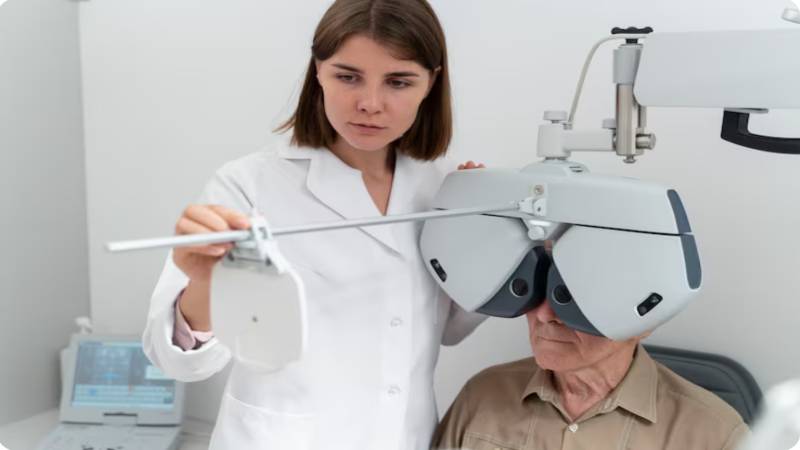
A cataract consultation is more than an appointment to confirm that the natural lens of the eye has become cloudy. It helps answer several practical questions: Is the cataract responsible for the vision problem? Is surgery appropriate now? Could another eye condition affect the result? Which replacement lens best fits the patient’s goals?
For Houston patients considering cataract surgery, knowing what happens during the visit can make the process feel more manageable. There may be several tests and unfamiliar terms, but each part of the consultation contributes to the surgical plan.
Amjad Khokhar, M.D., F.A.A.O., from Houston LASIK & Eye, explains that the medical findings should be considered alongside the patient’s daily visual needs. The consultation helps shape a treatment plan around the health of the eye, the patient’s routine, and realistic expectations.
The visit begins with how cataracts affect daily life
A cataract is a cloudy area in the eye’s natural lens. As it progresses, it can cause blurry or hazy vision, faded colors, sensitivity to light, halos, and difficulty seeing at night. Some people also need frequent changes to their glasses prescription [1].
The consultation usually includes a detailed discussion of how those changes affect everyday activities. The doctor may ask whether headlights make night driving uncomfortable, reading requires brighter light, colors appear duller, or vision is interfering with work, hobbies, or independence.
These details help establish whether the cataract is creating a meaningful limitation. The National Eye Institute explains that surgery is generally considered when vision loss begins interfering with activities such as reading, driving, or watching television. A cataract diagnosis alone does not mean surgery must be scheduled immediately [2].
Driving concerns can reveal limitations that are less obvious during a brightly lit eye-chart test. Cataracts may reduce contrast and increase glare even when a person can still read relatively small letters in the examination room. An earlier systematic review, published in 2008 and based on seven studies, found fewer reported driving-related difficulties after cataract surgery. The studies varied in design and outcome measures, so the finding supports a general benefit rather than predicting a specific result for an individual patient [3].
The visit should also cover medical and eye history. Patients may be asked about diabetes, previous eye surgery, eye injuries, allergies, steroid use, blood-thinning medicines, and other medications. This information helps identify factors that could affect surgical planning, healing, anesthesia, or the expected visual result [4].
Bringing an updated medication list and details of previous eye procedures can make this part of the appointment easier.
Testing helps the surgeon understand the eye as a whole
A cataract may be the main reason for blurry vision, but it is not always the only condition affecting the eye.
A comprehensive evaluation commonly includes visual-acuity testing, refraction, eye-pressure measurement, examination with a slit lamp, and a dilated retinal examination. These steps allow the ophthalmologist to assess the cataract while also looking for problems involving the cornea, retina, macula, optic nerve, or other eye structures [4].
That distinction matters because cataract surgery replaces the cloudy natural lens. It does not directly treat macular degeneration, glaucoma-related damage, corneal disease, or diabetic retinopathy. Surgery may still provide useful improvement when another condition is present, but the expected result may be more limited.
Measurements used to select the replacement lens are another important part of the visit. Ocular biometry records features such as the length of the eye and the curvature of the cornea. The surgeon uses those measurements with an intraocular lens formula to estimate the power of the artificial lens, or IOL, that will be implanted [5].
Patients may hear three common terms:
- Biometry: measurements used to calculate the replacement-lens power.
- Keratometry: measurement of the cornea’s curvature.
- Retinal imaging: scans used when the doctor needs a closer view of the macula or other retinal structures.
Modern formulas and measuring devices have improved lens-power calculations, but the result remains an estimate. No method can guarantee an exact refractive outcome for every eye [5]. The consultation should therefore include an honest discussion of whether glasses may still be needed after surgery.
The ocular surface matters as well. Dry eye can cause fluctuating vision and reduce the repeatability of corneal measurements. A review of cataract-planning evidence found that tear-film instability can affect keratometry and biometry, potentially influencing the calculated IOL power [6].
When dry eye is significant, treatment may be recommended before the final measurements are repeated. An additional visit can help the surgeon plan from a more stable optical surface.
Patients who wear soft contact lenses should ask whether they need to stop wearing them before biometry. One prospective study found that instructions about lens removal varied and suggested that some soft-lens wearers may be advised to stop for longer than necessary [7]. Because the study involved a small group and did not address every type of contact lens, patients should follow the clinic’s specific instructions rather than select an interval themselves.
Lens choices depend on vision goals and eye health
During cataract surgery, the cloudy natural lens is removed and replaced with an IOL [2]. During the consultation, the patient and surgeon can discuss the desired visual target for the replacement lens.
No single lens is best for everyone.
A monofocal lens usually provides one main focal range. Many patients choose a distance target and use reading glasses for close work. Others may discuss a near target or a monovision strategy, depending on their visual habits and how well their eyes tolerate different focal targets.
A toric lens is designed to address certain levels and patterns of corneal astigmatism. Its suitability depends on the corneal measurements, the type of astigmatism, and the overall health of the eye.
Multifocal lenses are designed to provide useful vision at more than one distance and may reduce dependence on glasses. Reviews comparing multifocal and monofocal lenses have found that multifocal lenses generally provide better unaided near vision and greater spectacle independence. They are also associated with a higher likelihood of visual effects such as glare and halos [8,9].
Those tradeoffs make lifestyle questions important. The surgeon may ask how often the patient drives after dark, how much time is spent reading or using a computer, whether sharp distance vision is the highest priority, and whether wearing glasses for some activities would be acceptable.
Eye health can narrow the options. Significant dry eye, corneal irregularity, macular disease, optic-nerve damage, or other conditions may affect whether a particular lens is advisable. Previous LASIK or PRK should also be discussed because corneal refractive surgery can make replacement-lens calculations more complex and may require specialized formulas or additional measurements [10].
Financial considerations may be discussed as well. Patients should ask the clinic and their insurer which parts of the procedure are covered and whether a particular lens or technology option involves an additional charge. Coverage depends on the policy and the treatment selected.
The best questions help set realistic expectations
A useful cataract consultation should leave the patient with a clearer understanding of the diagnosis, the available options, and what happens next.
Questions worth bringing include:
- Is the cataract the main reason my vision has changed?
- Do I need surgery now, or could I safely wait?
- Is there another eye condition that may limit improvement?
- Does dry eye need treatment before the measurements are final?
- Which lens options are appropriate for my eyes?
- What distance will the recommended lens target?
- How likely am I to need glasses afterward?
- What visual effects or tradeoffs should I understand?
- What should I expect during recovery?
- Which symptoms after surgery require an urgent call?
Bringing a family member or trusted friend can be helpful when several options are being discussed. Taking notes is reasonable too. A patient should not feel pressured to select a lens before understanding what it may provide and what it cannot guarantee.
According to information supplied by the practice, Houston LASIK & Eye evaluates patients using ocular measurements, examination of the cornea and ocular surface, and discussion of lifestyle and daily vision goals. The practice also offers laser-assisted cataract surgery and several IOL options. These services are intended to support an individualized decision rather than the same recommendation for every patient.
Someone who drives frequently at night may weigh lens tradeoffs differently from someone whose main priorities are reading and computer work. A patient with retinal disease may also need different expectations from a person whose cataract is the only significant eye condition.
Careful testing and clear explanations allow patients to weigh their options with a realistic understanding of the likely result. The consultation should connect the health of the eye with the activities and visual demands that matter most in everyday life.
Medical note: This article is for educational purposes only and does not replace a comprehensive eye examination or individualized medical advice from a qualified ophthalmologist.See More
References
[1] National Eye Institute. (2025). Cataracts. https://www.nei.nih.gov/eye-health-information/eye-conditions-and-diseases/cataracts
[2] National Eye Institute. (2024). Cataract surgery. https://www.nei.nih.gov/eye-health-information/eye-conditions-and-diseases/cataracts/cataract-surgery
[3] Subzwari, S., Desapriya, E., Scime, G., Babul, S., Jivani, K., & Pike, I. (2008). Effectiveness of cataract surgery in reducing driving-related difficulties: A systematic review and meta-analysis. Injury Prevention, 14(5), 324-328. https://doi.org/10.1136/ip.2007.017830
[4] American Academy of Ophthalmology. (2022). Cataract in the adult eye Preferred Practice Pattern. Ophthalmology, 129(1), P1-P126. https://doi.org/10.1016/j.ophtha.2021.10.006
[5] Kane, J. X., & Chang, D. F. (2021). Intraocular lens power formulas, biometry, and intraoperative aberrometry: A review. Ophthalmology, 128(11), e94-e114. https://doi.org/10.1016/j.ophtha.2020.08.010
[6] Nibandhe, A. S., & Donthineni, P. R. (2023). Understanding and optimizing ocular biometry for cataract surgery in dry eye disease: A review. Seminars in Ophthalmology, 38(1), 24-30. https://doi.org/10.1080/08820538.2022.2112699
[7] Goudie, C., Tatham, A., Davies, R., Sifton, A., & Wright, M. (2018). The effect of the timing of the cessation of contact lens use on the results of biometry. Eye, 32(6), 1048-1054. https://doi.org/10.1038/s41433-018-0019-1
[8] de Silva, S. R., Evans, J. R., Kirthi, V., Ziaei, M., & Leyland, M. (2016). Multifocal versus monofocal intraocular lenses after cataract extraction. Cochrane Database of Systematic Reviews, 12, CD003169. https://doi.org/10.1002/14651858.CD003169.pub4
[9] Khandelwal, S. S., Jun, J. J., Mak, S., Suttorp Booth, M., & Shekelle, P. G. (2019). Effectiveness of multifocal and monofocal intraocular lenses for cataract surgery and lens replacement: A systematic review and meta-analysis. Graefe’s Archive for Clinical and Experimental Ophthalmology, 257(5), 863-875. https://doi.org/10.1007/s00417-018-04218-6
[10] Anders, P., Anders, L.-M., Barbara, A., Szentmáry, N., Langenbucher, A., & Gatzioufas, Z. (2022). Intraocular lens power calculation in eyes with previous corneal refractive surgery. Therapeutic Advances in Ophthalmology, 14, 25158414221118524. https://doi.org/10.1177/25158414221118524